Having the correct nocking point height is crucial to having an arrow that flies in a way that its pointing in the direction that it’s moving. If the nocking point is considerably high or low, the arrow will look a bit like this when it comes out of the bow if viewed from the side:
If the nock point is at the low end (near 0 mm), then the back of the arrow will be fairly close to the shelf of the bow and the fletches may hit it in passing. If this happens in the same way every time, then that can be perfectly consistent even if it does cause some wear to the fletch thats being repeatedly deformed. If it only occasionally hits (when the archer flubs their release) then the arrow would be expected to be deflected somewhat.
If the nock point is at the high end, it’s less clear what’s it’s likely to look like. During the time when the arrow is in contact with the arrow rest, which is only the first few milliseconds of movement, the arrow angle will be changing significantly as the nock end gets closer to the bow. This could press the arrow shaft into the arrow rest, making it more likely to break over time.
I decided to take a series of videos to see how changing the nocking point affected the amount the shaft moved up and down while it was still in contact with the string, and how much the fletches touched the bow. I was also interested to see what the flight looked like when at my “ideal” nocking point height, and whether the flight was similar for a wide range araound this point or if changed rapidly on either side of that region.
In my case, “ideal” means about 9 mm above the zero line, and was determined by shooting fletched and bare arrows until they both hit the target at the same height and angle at 8-30 m. This is a pretty standard procedure. The idea is that when the path that the tail of the arrow follows is above or below the path that the point follows, the tail experiences more drag. If the tail has fletches on it, then it will rotate so that the tail is following the point after a few meters. If the tail has no fletches, it will experience less drag and will rotate much more gradually. So if the two arrows land in the same place, that means that the arrows were flying with the tail following the point.
The “ideal” nocking point is quite dependent on the archer – if the pressure on the string from fingers below the string changes relative to the pressure from the finger (if any) above the string, this changes how the arrow moves up and down between when the arrow is released and when it leaves the string. Likewise, changing the height of the grip and the position of the pressure point on the grip affects the relative pull of the top and bottom limbs on the arrow and changes the arrow flight. So there is nothing special about my current preferred nocking point height other than it works for me.
The test can be done at longer distsances and indeed the result is more sensitive, but the slightly increased drag on the fletches compared to a bare shaft means the former will drop more, which will give a higher “correct” nocking point height than at shorter distances. At 70 m, the nocking point height that gives bare and fletched arrows in the same group is several mm higher than the one at 20-30 m.
Definitions
Firstly, the nocking point height can be defined in several ways depending on whether someone has one or two nocking points, and whether they mean the top or bottom of the top or bottom nocking point, or the middle of the arrow nock. The most common definition though is the bottom of the top (or only) nocking point as the nock of the arrow naturally rests against this point when nocked. That is the definition I’m using.
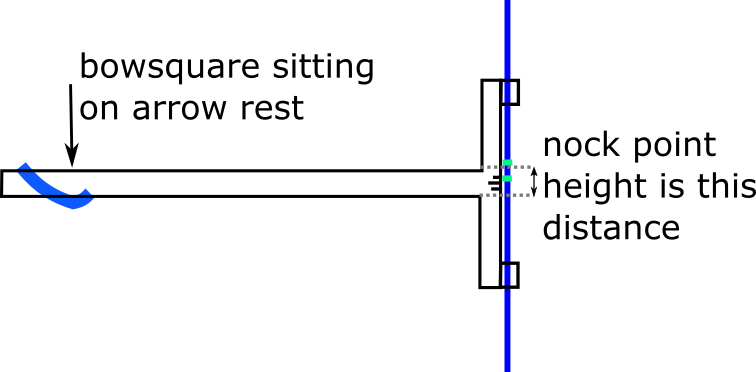
Many bowsquares have a “0” line which is halfway between the top and bottom of the bowsquare. This is so that it works equally well left and right handed; it’s not an actual 0 line.
When the nocking point height is set to 0, the arrow point is pointing slightly up because the arrow nock does not have zero thickness. To have the arrow at excatly 90o to the string, half the height of the arrow nock would need to be added.
Method
I used my regular bow setup. It gives the loose nock fit recommended by the Easton tuning guide: if I give the string a good flick a few inches away from the nocking point, the arrow drops off the bow. I changed the nocking point height by rotating a homemade nock and measuring the height with my bowsquare, which has an increment of 1mm. The uncertainty in each value was a bit less than half a mm.
The camera, a Sony RX100 mkIV was set to the highest frame rate of 1000 fps. To minimise arrow motion blur, the shutter was at the maximum setting of 1/12800. As the arrow has a speed of about 63 m/s after leaving the string, it travels 4.9 mm during each frame so there is still a noticeably amount of motion blur. As such high shutter speeds require a significant amount of light, a 500 W halogen light was pointed at the bow window from about 20 cm away. The vanes used were mylar Spin-Wing vanes which extend 7 mm away from the arrow and are 45 mm long.
The clicker was used for each arrow, though as the reaction time of 15 ms between the clicker falling and the arrow beginning to move would double the video length, each clip was cut to begin as the arrow started to move.
Result
The playback speed can be reduced by clicking on the gear symbol, and you can move frame by frame with the “,” and “.” keys.
As the camera was at the same height as the arrow, only vertical movements of the shaft are visible. The bending of the arrow in the horizontal plane is not seen. These arrows are matched to the bow and archer, and there is considerable clearance between the arrow rest and button and the back end of the arrow as it passes the bow.
The movement of the clicker after the arrow has left the bow was a surprise. However, the clicker is a fairly flexible piece of spring steel and a considerable amount of vibration (about 13 J) is dissipated in the bow after the arrow leaves.
At low heights
The lowest nocking point height that gave clearance for the spin-wing vanes was either 6 or 7 mm. Due to the motion blur it’s a bit ambiguous which it is. If I’d been using 4″ plastifletch vanes which are 13 mm tall instead, then the minimum for clearance would have been around 10 mm if a vane was pointing straight down. If the vane was 30o away from horizontal as is common when three fletches are used, the minimum would be halved.
I also did a few shots while either pushing the bow with the heel of my hand, which moved the tail of the arrow 2 mm lower as it was passing the button, and the webbing between my thumb and index finger, which moved the arrow 2 mm higher. These represent the extremes of pressure point. In practice, I would expect my natural inconsistency in bow hand pressure to contribute about 1 mm of variability to the arrow clearance.
With only one shot per setting, it’s impossible to be definitive, but the clearance between the shaft and the arrow shelf increases somewhat linearly from 4 mm at a nock height of 0 to 14.5 mm at a nock height of 16. The available data isn’t enough to tell whether there would still be a plateau from 9 – 14 mm if I redid those settings several times.
Is clearance necessary? It doesn’t seem to be the case with feathers, which are are often thick enough that they always hit the bow somewhat. Vanes that don’t clear the bow tend to leave a build-up of plastic on the bow, which itself isn’t much of an issue but does increase arrow maintenance. Spin-wings are quite fragile and crease easily so any contact is undesireable. However, a feather (or vane) that always brushes past the riser with a similar amount of contact is consistent. A somewhat stiff vane that sometimes clears the riser and sometimes doesn’t is a way to introduce error since some small arrow deflection caused by the vane contact is likely.
At higher heights
As the nocking point height is increased above 9 mm, the amount the shaft moves up and down in flight increases. This is best seen by comparing the height of the shaft as it passes the clicker
Best height
From the videos alone, I don’t have any data that would indicate a particular ideal value. While values too low for vane clearance would be undesireable, the increased wobble at higher values doesn’t have a clear downside that I’m aware of.
The height that gave the straightest flight in terms of total vertical motion of the shaft was at 9 mm +- 1 mm. This is also the height that gives the straightest flight according to the bareshaft test. It’s refreshing that there is at least a correlation between the two.
However, I can’t say that 9 mm gives me any better accuracy than any other value. It’s possible that it does, but I haven’t done any testing that would give me an idea of it. I’ve used a range of nocking point heights from 6 – 12 mm at different times, either for a non-performance based reason like having the same sight mark for bareshafts and fletched arrows at 70 m, or by accident.
While minimising the angle between the arrow shaft and the direction of flight does reduce drag, I don’t know if it’s by a significant enough amount to care. Besides, the arrow with the least drag is not necessarily the best grouping arrow. However, I don’t have any evidence and I haven’t seen any systematic tests of nocking point height and group size yet, though there are enough anecdotes that it’s worth testing, and the anecdotes indicate a large enough difference in group size that it should be possible to run the test without needing hundreds of arrows per nocking point height.
This is a topic that I’ve come across several times in different forums. There is the concept that when an olympic-style bow/arrow/archer system is tuned, the arrow speed will be higher than if it is out of tune. In other words, that there’s something about a tuned system that optimises energy transfer to the arrow. I’ve seen this repeated many times, generally along the lines of: when the bow is tuned, the arrow will be faster and therefore there will be less vibrational energy left in the bow. The only instance I’ve found that implies that this idea is based on actual evidence is from Vittorio on ArcheryTalk in 2006, who said that he’d previously measured this with a chronograph. In a post on the long-defunct Sagittarius blackboard in 2003, he said “The efficiency of the bow increases with tuning. This may generate up to 2fps more (recurve) from a well tuned to a poorly tuned bow. This s another factor, and a poorly tuned bow or a critycal one (too close to the limit) ill surely be morenoisy than perfely tuned machines.” Unfortunately there wasn’t any other information about the test (or any of the results).
A 2 fps (0.6 m/s) difference in speed is within the capabilities of my chronograph. I thought it would be interesting to make a test that looked at the effect of arrow spine without other variables that affect arrow speed.
What does “tuned” look like?
The definition of “tuned” used in these cases is based on a bareshaft landing either in the same place as the fletched arrows (most commonly), or slightly to the stiff side of them, by some small amount chosen by the archer based on what combination of bow settings feels optimal after iterating through all the variables available to them. In the latter case then this is slightly arbitrary as any position could be called “tuned” if the archer says so and there doesn’t appear to have been a consensus about how much the two should deviate. Only “slightly arbitrary” because the bareshaft is still somewhere nearby on the target, and which means there’s still only a fairly narrow range of possible conditions.
How would the arrow “know” which condition is considered to be in tune by the archer, and how could this be distinguished from a speed increase with a different cause? Perhaps there more to it when the definition of tuned means that the bareshaft lands with the fletched arrow, as this implies that the arrows are moving in the direction that they are pointing as they leave the bow since under this condition the addition of extra drag at the back of the arrow (fletches) doesn’t change its direction.
Calculating arrow speed
The factors that are likely to be changed when tuning a bow and which have a significant effect on arrow speed, are the draw weight, arrow mass (by changing points or nocks or arrow size), and brace height. The effect of each of these on the expected arrow speed can be calculated pretty accurately with the equation below. After a great many chronograph tests with different draw weights, brace heights, and arrows, I haven’t yet noticed any significant discrepancies between the speeds calculated by the equation and the ones I’ve measured.
where: is the arrow speed, is the draw weight, is the distance the arrow moves when being drawn back, so = arrow length – brace height – length of arrow in front of the pressure button at full draw,
is a unitless number that indicates how much extra energy is stored during the draw relative to a bow where the increase in draw force varies linearly across the whole range. It is constant for a given draw force curve – which means that if the draw weight is adjusted by changing the angle of the limbs, the constant will change also. It’s a number between 1 and maybe 1.5 for a recurve bow (1.16 for my bow with Samick Extreme limbs which have a “conventional” geometry and are made from carbon fibre+foam). If the integral of the draw weight over the draw length was used instead of just force x displacement, then the constant wouldn’t be needed.
mass is for the whole arrow, is the virtual mass. There’s more detail about it here, but for now it’s just a constant to account for the fact that while the arrow is accelerated to v, different parts of the string and limbs are accelerated to other lower speeds, from the part of the string next to the nock being accelerated the same amount as the arrow, all the way to the base of the limbs barely moving. Each bit of moving mass has some kinetic energy. The virtual mass is the mass that, if it were moving at the same speed as the arrow, would have the same total kinetic energy as the string and limbs. It’s a number determined by the limbs and string (and the riser too if it’s not very stiff) and it’s in the ballpark of about 100 grains for a recurve bow.
The default units for the above are Newtons for the force, kg for the masses, and meters for the lengths. But if you want to instead use pounds for draw weight, inches for draw lengths, grains for masses, and get a result in feet/second, you should use those units and multiply the final number by 137.
Looking at this equation, arrow speed should:
increase with the square root of the draw weight
decrease approximately with the square root of the brace height
decrease approximately with the square root of the arrow mass
So this means that if we want to see how arrow tune, and arrow tune alone affects the arrow speed, then the draw weight, brace height, and arrow mass must be kept constant. Otherwise, we can’t say whether an observed change in speed is caused by the arrow being in or out of tune or one of the above factors. So, to test this we’d need arrows that are too stiff, just right, and too weak that all weight the same.
Controlling variables
In order to make sure that any change in speed comes from the arrow tune only, we need to eliminate all other differences between the arrows.
Nock fit has a small effect on speed. So all arrows tested must use the same nocks.
Draw length has a large effect on speed. If the different arrows used don’t have the exact same length, then the clicker will need to be reliably adjusted to accommodate this. Using the above equation, accidentally having the clicker 1mm too far out or in changes the speed by 0.07 m/s (0.2 fps). To minimise this error, lines for clicker placement were marked at the correct distance for each arrow. The estimated accuracy of clicker placement is about 0.5 mm.
The speed is measured using a chronograph. In this case, it’s a magnetic chronograph with two coils 54 cm apart. The speed is calculated from that distance and the time between the magnetised arrow tip passing through each electrical coil, which induces a current in that coil. The precision of measuring the time between the two spikes is 0.01 ms, and a measurement that’s inacurate by that amount would change the speed by 0.08 m/s. The distance between the coils is constant, so any error will affect all speeds equally. If the distance was off by 5 mm, then all the speeds would be off by about 0.6 m/s.
Arrow mass needs to be the same. In practice, this means to within 0.2 grains (15.432 grains = 1 gram). If an arrow is 0.2 grains heavy then the expected difference in speed is 0.01 m/s
The bow and archer need to be the same. The string has already been broken in and there is no change in brace height during the session. As the archer’s form could change over the course of an end and over the session, the different spines of arrow should be shot at the same end, and with the order or the arrows varying between ends. I’ve previously found that if I’m not at anchor and release when the clicker goes, the speed can be reduced by 2 m/s despite the draw length being ostensibly the same. For “normal” shots, the standard deviation is about 0.3 m/s, meaning that 2/3 of my shots fall within a range of 0.6 m/s
Experimental setup
All arrows were shot by me using the same bow indoors. The bow was a modern recurve bow with a sight, clicker, pressure button, arrow rest, and stabilisers. The draw weight was measured as 40.6 lbs. The chronograph was placed just beyond the reach of the stabiliser, about 1.5 m in front of the archer. The target was at the same height as the bow. Other than adjustment of the clicker to account for the different arrow lengths, no changes were made between arrows or shooting sessions.
Arrow properties
The total mass of each arrow was 302.6 grains. This weight was chosen because I happened to have arrows of about that weight that were too stiff, too weak, and “in tune”. For arrows that were a grain or so under, copper tape was used at the nock end to make it match. This did not have a significant effect on the balance. Two arrows were used for each condition. Bareshafts were used to prevent clearance issues associated with large vanes and untuned arrows. As the lengths varied, lines were drawn on the riser so that the clicker could be adjusted reliably to within 0.5 mm to give the same draw weight for each arrow.
Arrow
Spine
length
vibration frequency
tune
in thou
cm, nock groove to tip
Hz
ACC
750
71.0
71, 74
very weak
ACE
620*
70.5
87
about right
ACE
520
71.9
88
stiff
ACE
470
72.2
92
very stiff
About 15mm had been removed from the back of these arrows, which stiffened the spine by several pounds.
These are all arrows that I already had lying around.
ACC 750: at least a few years old when my coach gave them to me about a decade ago. I shot them for about a year, and they’ve been lent out to other people a fair bit. They’re a bit scratched up but fly perfectly fine.
ACE 620: bought new around 2011 and in constant rotation since. The labels are still just about visible. They still land in the same place as much newer shafts. About a year ago, I cut about 15 mm from the back (not recommended by Easton). Cutting length of the back is supposed to give a larger stiffening effect than cutting the same distance from the front as it moves the wider middle part of an ACE shaft farther back. This was so that I could use heavier 110 gr points and still have them bareshaft tune as part of a different experiment.
ACE 520: old shafts given by my coach about a decade ago to play around with making bowstands. The labels are mostly worn off so they probably had quite heavy use before they were retired. They’re “Series G” instead of “Series H” which all the other shafts are, so it’s possible there’s something slightly different about the grade of carbon fibre or type of resin used or the way they were made as changes to the series number indicate some (probably very) slight change to manufacture. The surface feels a bit smoother and more polished than the other shafts over the entire length. They look very slightly darker than the other ACEs.
ACE 470: impulse bought as “for parts only” on eBay for £37 for a dozen shipped. It turned out they were only lightly used and a few looked unshot.
Each arrow was shot at least 10 times, to give at least 20 shots per spine. Within an end, they were generally shot from longest to shortest or vice versa.
Speed measurement
The speeds were measured using a copper coil induction chronograph with a sample rate of 88200 Hz and a distance between the coils of 0.53 m. When a magnetic item like an arrow point that has been swiped against a magnet passes through a wire coil, it induces an electric current in that coil. This is interpreted as “sound” if the cable is plugged into the microphone jack of a computer and the time between the two spikes can be measured. The sample rate used gave a maximum precision of 7 cm/s. As the chronograph was fairly robust, the distance between the coils was constant to within 1 mm, which gave an uncertainty of 11 cm/s.
The other likely source of variation in speed is the release of the archer. The speed of an arrow released when at full draw but improperly anchored due to inconsistent form is generally up to 2 m/s less than usual. The natural variation for “normal” shots varies day to day due to archer inconsistency but is in a range of 0.2-0.5 m/s.
Results and Discussion
Visible flight
To start, here’s what the arrows looked like at a few distances. The dark blue ACEs are my regular arrows and the bareshafts fly pretty straight and have the same horizontal position as the fletched arrows. They were included as a reference but weren’t part of the test as they weigh about 263 grains and I wouldn’t be able to add enough extra weight without it having a large effect on the spine.
The orange and green arrows are stiffer spined ACEs. The magenta ones are much weaker ACCs. When the light is right, I can see them curving in flight indoors. Outdoors, the 520 and 470 are about a foot or so stiff at 30m, and the ACC 750s are about a foot weak, relative to fletched and bare tuned arrows. This isn’t meant to be terribly precise – it’s just to give a ballpark indication that the stiff and weak arrows are definitely that, and that the ones I think are tuned are. While the short distances mean that the arrows would still be vibrating significantly in the horizontal plane when they hit the target, the amplitude of that vibration is only a few cm at most and is far outweighed by the angle of the arrow relative to the direction of flight.
Archer position was a bit off to one side at 8m – the dark blue arrows were approximately parallel to the line of flight at all distances.
Arrow speeds
The measured speed was not affected by whether or not the arrow was tuned, at least to the extent that’s visible with a sensitive chronograph.
Spine
Speed
Standard deviation
shots
m/s
m/s
470
60.64
.30
25
520
60.82
.30
28
620
60.67
.29
21
750
60.67
.25
20
Table of average arrow speeds measured for each spine.
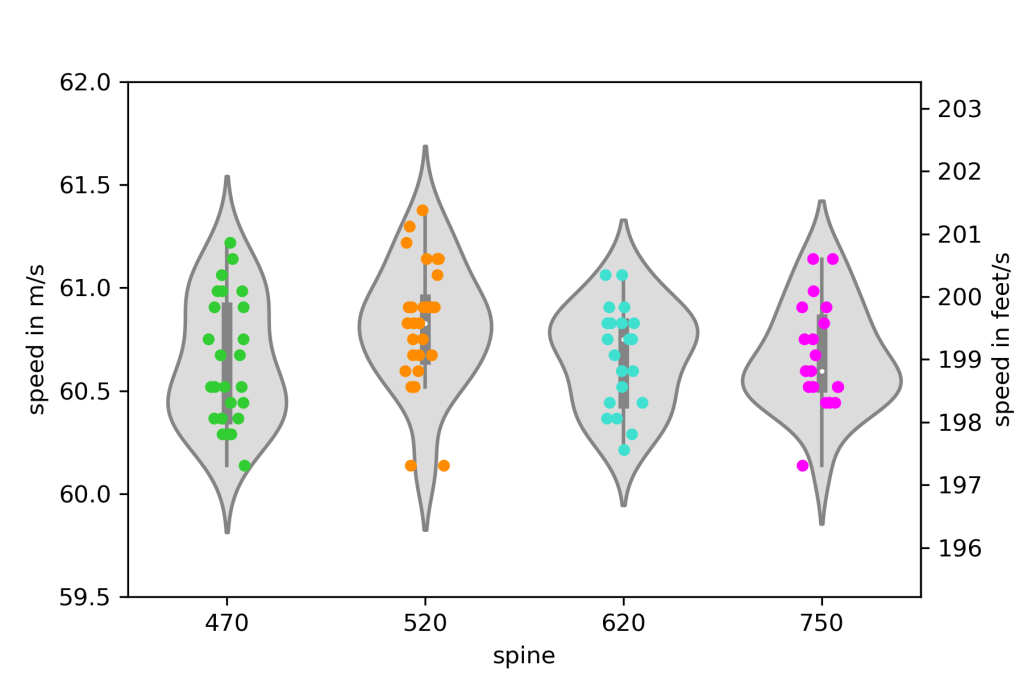
Violin plot showing the distribution of speeds for each spine of arrow shot. The scatter of points in the x direction is to make them more visible and does not indicate any change in spine.
Except for the 520 spine, none of these sets of data show a result that’s incompatible with the difference in speeds just being caused by random chance. If we use Student’s t-test, which is a statistical tool used to determine whether it is likely that two sets of data have the same average, to compare the speeds found for each arrow spine, we find that the difference is more likely attributed to random chance than to a difference in the actual average speed.
What about the 520 spine? Using that same test gives 90-96% confidence that there is a real difference between the average speed for that spine relative to the others, in other words that it wasn’t just random chance that caused the average speed to be a bit higher than the other arrows. As I shot multiple spines in each end, and alternated the order to cancel out any effect from my form changing during or between ends, I’m pretty confident that the difference isn’t caused by the way I shot them. The difference in speed between the 520 spine and the others isn’t big – about 16 cm/s, or 0.5 fps. The only odd thing about the 520s is that the surface looked a bit smoother and darker than the other arrows. With the labels hidden, both I and another person could pick out the 520s among the other arrows from their appearance so it’s not just my imagination.
It’s possible that there was just enough less friction against the arrow rest and pressure button to be noticeable. At some point in the future, I could repeat the test but using a significantly different draw weight. Then I could see whether the 520s being ever so slightly faster was because of some odd property of arrows that are two spines too stiff, or if it’s something specific to how those particular shafts were made.
So, what does this mean?
It definitely means that I can continue to calculate arrow speed based on the arrow mass and draw force curve without having to account for whether or not the system is tuned. For me with my bow and my arrows, there is currently no measureable effect on the speed caused by shooting a tuned or weak or stiff arrow. I do not expect that if I shot a different olympic-style recurve bow that any effect would appear, nor would I expect a different person shooting my bow to see an effect.
It does not mean that it is impossible for arrow spine to influence arrow speed for anyone else. However, I think it would be very unlikely, at least for olympic-style recurve bows as there isn’t a mechanism that I know of that would be responsible for this effect. If anyone has any data or simulation that shows a different effect, I would be glad to see it and try to reproduce it myself.
What about other situations?
Without testing a wide range of bows and arrows that I don’t own, or using a release hand that’s not mine, it’s impossible to be 100% confident about whether these results would be different in another situation. The closer the situation is to a human using an olympic-style recurve bow and modern arrows that are within several spines of the “correct” one, the more confident I am that this result would be repeated.
What about the stiffest and weakest spines?
If the weak arrows are so weak that they’re in danger of breaking, then some of the bow’s energy might go into irreversibly bending or cracking the arrow instead of pushing it towards the target. If the arrow is infinitely stiff, then it won’t bend at all when released and instead it’ll rotate and push much more into the pressure button as it slides past, which maybe could give a measurable frictional loss. However, those situations are unrealistically far away from the sort of scenarios that might be encountered when shooting.
Traditional bows
A tuned arrow should clear the sight window without hitting anything. A stiff or weak arrow, depending on how untuned it is and whether the sight window is cut close to the center of the bow, may hit or slide against part of the bow some or all of the time, which would cause some friction and maybe reduce the speed by a measurable amount. With a longbow or many traditional bows where the arrow position couldn’t be adjusted to be straight down the center of the bow, then a significant amount of unavoidable contact would be likely when far too stiff or far too weak spines were tested. I do not see how the energy imparted to the arrow by the bow could be separated from the energy removed by it rubbing against the bow.
In order to measure the effect over the (smaller) range of spines were arrow clearance was ok, the draw length would need to be consistent to within a mm, the bow would need to be the same draw weight for the whole test (which can be an issue with non-laminated wooden bows). To get the speed consistent to within 0.3 m/s, the draw weight would need to not vary by more than 0.4 lbs when held at full draw, and the draw length would need to be consistent to within 2 mm. So it would be more effort to gather the same data, but possible. A laminated bow with some sort of clicker attached could work.
Nock friction
A tuned arrow is generally accepted to leave the string at a specific stage in its bending cycle. Looking at high speed videos of top international archers at competitions (so hopefully they though their arrows were tuned) like this or this or this (at 6:25 and 6:30), when the arrow leaves the string the point is pointing toward the bow side but is a few milliseconds away from being straight. A stiffer arrow bends back and forth more quickly, so will have be closer to straight when it leaves the string, and a weaker arrow bends more slowly so will be more bent when it leaves. So unless the arrow leaves the string when it’s at its maximum bend in either direction, there will be some amount of sideways force on the nock as it detaches from the string. I included the bending frequencies of the arrows I tested in the table with the information about each arrow. There’s quite a wide range: in the time for the weakest arrow to vibrate by one cycle, the stiffest one has vibrated 1.27 cycles. The speed at which the arrow bends in free flight may be a bit different to when it’s still attached to the string, but that difference should be the same for all arrows shot from the same bow. So we can be pretty confident that the bend of these arrows would have looked different at the moment they left the string and therefore that the nocks would have been at different angles when it left the string. However, that bit of friction between the nock groove and string wasn’t enough to change the speed. If nocks were made out of a material with much more friction against the center serving (like coarse sandpaper or a sticky rubber) instead of smooth plastic, then it’s possible that this effect would cause a noticeable difference in the speeds.
Drag
An untuned arrow that leaves the bow oscillating initially in a direction that’s different to the movement of its center of mass should experience more somewhat drag than one flying (on average) in a straight line towards the target. If a chronograph was set up in front of a target 70 m away instead of just in front of the archer, there might be a noticeable speed difference between arrows of the same weight but a different spine.
However, the arrow diameter and length also affect the drag considerably. If an arrow like an ACE loses about 10% of its speed on the way to a 70m target, then an ACC with a 10% larger diameter and 21% larger frontal area might lose closer to 20% – definitely a significant difference. So the arrows used to test this would need to have the same weight, length, and diameter which means only the internal diameter and material would be able to vary. In practice, that severely limits the possibilities for such a test.
A graph with some possible regions is shown below. Black boxes indicate areas where 3 or more different spines of arrow with a 28″ shaft and recommended point weight have similar diameter end weight but different spines. Between cutting the shafts to account for different point lengths, and careful choice of the nock system for each, sets of arrows matched to within a grain and with diameters within 0.015″ (0.38 mm) could be tested at long distances. The widest range of suitable spines is found at 250 grains, where arrows with spines from 1400 to 670 could be compared if suitable draw weight at which the 1400 shafts were weak but not in danger of breaking was used. To mitigate the possible effect of different friction forces between different arrow materials against the arrow rest and button, tape could be applied to the contact regions.
Graph of arrow weight against external diameter. The point weights used were the average recommended value. Where none could be found, the average value for similar shafts were used. In In the case of the ACE which is wider at the center, the diameter is the maximum diameter. The diameter at the ends is closer to about 0.205″. The spine numbers of the arrows in the black boxes are adjacent to them.
I don’t have a suitable set of arrows for this test, though I may revisit it in the future.
Overall conclusions
Tuned arrows didn’t fly any faster than stiff or weak arrows
I don’t need to add a “tuning constant” into the equation that I use to estimate arrow speeds.
There’s something a bit odd about my 520 spine arrows which are much smoother than the others.





 is the arrow speed,
 is the draw weight,
 is the distance the arrow moves when being drawn back, so
  is a unitless number that indicates how much extra energy is stored during the draw relative to a bow where the increase in draw force varies linearly across the whole range. It is constant for a given draw force curve – which means that if the draw weight is adjusted by changing the angle of the limbs, the constant will change also. It’s a number between 1 and maybe 1.5 for a recurve bow (1.16 for my bow with Samick Extreme limbs which have a “conventional” geometry and are made from carbon fibre+foam). If the integral of the draw weight over the draw length was used instead of just force x displacement, then the constant wouldn’t be needed.
 mass is for the whole arrow,
 is the virtual mass. There’s more detail about it

 nocktopoint.com